
Peregrine Audubon Society's chapter meetings and programs are generally held on the third Tuesday of each month, September through May, at 7PM. Exceptions are the November and December meetings. The November 28 meeting is a Tuesday and the December 11 meeting is a Monday. We'll update details of our 2023-2024 schedule as they become available.
All programs except January and February will be held at 7PM in the City Council Chambers of the Ukiah Civic Center at 300 Seminary Avenue, Ukiah. The public is always welcome.
Our January and February programs will be held on Zoom. To receive links, subscribe to our mailing list on our home page.
| Board | Programs | Field Trips | ||
|---|---|---|---|---|
| September 7 | September 19 | Robert B. Douglas on What's Going on with Barred and Spotted Owls? | September 23 | Clear Lake State Park |
| October 3 | October 17 | Carrington Hilson on Elk in Coastal Northern California | October 21 | Willits WWTP and Mitigation Lands |
| November 7 | November 28 | Art Haschak on Peregrine Falconry | November 18 | Covelo and Round Valley |
| December 5 | December 11 | Get to Know Your Local Birds! | December 16 | Ukiah CBC |
| January 2 | January 16 | Karla Bloem on a Real Life Great Horned Owl Soap Opera | January 20 | Sacramento NWR |
| February 6 | February 20 | Leslie McGinnis on Monarch Butterflies in the Garden | February 24 | Ukiah WWTP |
| March 5 | March 19 | Ashton Kluttz of the Sonoma Bird Rescue Center | March 23 | Lake Mendocino North Shore |
| April 2 | April 16 | Peter Van De Burgt on Salmon Habitat Restoration on the Ten Mile and Garcia Rivers | April 27 | Hopland Research and Extension Center |
| May 7 | May 21 | Dave Bengston on Attracting Birds to Your Yard | May 4 | Potter Valley and the Eel River |
Board meetings generally take place on the first Thursday of each month, September through May, at 7 PM. Contact a board member for details. Board meetings are open to the membership. You are always welcome and encouraged to participate.
Chapter Meetings and Programs
Robert B. Douglas on What's Going on with Barred and Spotted Owls?
Tuesday, September 19, 2023 at 7PM - Ukiah City Council Chambers
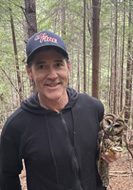
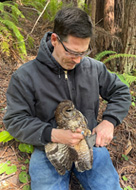
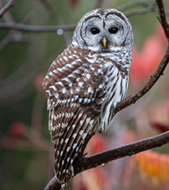
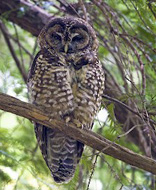
Robert B. Douglas with Northern Spotted Owls at Mitchell Creek and Caspar © 2023 Robert B. Doublas. Barred Owl © 2023 Blair Dudeck, Northern Spotted Owl © 2023 Logan Southall.
Tonight Robert B. Douglas will present a program about the participation of Jackson Demonstration State Forest (JDSF) in a barred owl removal study that was designed to address regional northern spotted owl population decline. Robert will speak about spotted owl population trends, societal views, conservation implications, and the future of barred owl management. He will be joined by Kyle Farmer, Community Education Specialist, U.C. Cooperative Extension, Mendocino County. He has a background in international development, sustainable agriculture, and prescribed fire, and is currently undecided on the barred owl question. Kyle will be sharing a brief history of the Barred Owl Stakeholders Group – a series of stakeholder meetings led by Clark University ethicist Bill Lynn to explore this challenging topic.
Robert is Senior Environmental Scientist (Specialist) working as the State Forest Biologist for Jackson Demonstration State Forest since 2021. He has a B.S. degree in Environmental Biology from Humboldt State University (1997) and a M.A. degree in Ecology and Systematics from San Francisco State University (2003). Prior to state service, Robert worked as a biologist to improve conservation and management of non-timber forest resources on industrial timberlands in Mendocino County. He has a broad interest in natural history, conservation biology, and forest ecology which has led him to work on diverse array of projects to better understand how disturbance and other environmental factors influence plant, fungal, and animal communities over time. Some of the projects he has been involved with during his career include research on belowground fungal communities in different forest stands, spotted owl nest-site characteristics, songbird habitat associations, salmonid population dynamics, carnivore distribution, tailed frog and giant salamander population genetics, and the post-fire response of redwood.
The focus of Robert’s position at JDSF is to provide technical expertise in the conservation and management of non-timber forest resources (fungi, plants, fish, herpetofauna, birds, mammals, and other wildlife) associated with disturbance activities that occur on the forest (e.g. timber harvesting, fire and fuels management, recreation, restoration, and research). His primary responsibility is to ensure that JDSF projects comply with the law (e.g. Forest Practice Rules, CEQA, and federal and state endangered species acts) and the forest management plan. He is also developing a plan to monitor the diversity and distribution of species across the forest to better understand how their populations change over time with habitat and other environmental changes. This involves collaborating with outside researchers, agency biologists, user groups, and conservation organizations to conduct experiments (e.g. invasive species control, fuel treatments, etc.) and/or restore habitat, the results of which will inform and guide future management across the forest in an adaptive management framework.
Carrington Hilson on Elk in Coastal Northern California
Tuesday, October 17, 2023 at 7PM - Ukiah City Council Chambers
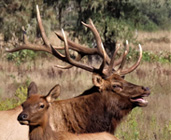
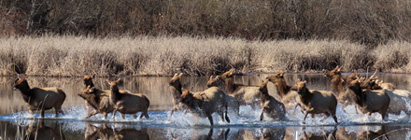
Bull Tule Elk and calf and Tule Elk running © 2023 Marisela de Santa Anna
This evening Carrington Hilson will present on elk research and management in coastal northern California, including Del Norte, Humboldt, and Mendocino counties.
Carrington is the Elk Research Biologist for the California Department of Fish and Wildlife in the Northern Region. She has a B.S. degree in Biology from Virginia Polytechnic and State University (2004) and a M.S. degree in Wildlife from California State Polytechnic University, Humboldt (2013). Prior to starting her work with elk in 2016, Carrington was the Wildlife Disease Biologist for the Arizona Game and Fish Department, managing the statewide chronic wasting disease surveillance program and performing captures statewide. Some of the projects she has been involved with during her career include pronghorn and bighorn sheep relocations, disease in wildlife and livestock, ecology of sylvatic plaque, West Nile virus detection, and demography of small mammal, passerine, and raptors.
The focus of Carrington’s position is to obtain a comprehensive assessment of elk populations and their ecology in northern California. Obtaining an accurate estimate of Roosevelt elk (Cervus canadensis roosevelti) and tule elk (C. c. nannodes) populations in northwestern California is difficult because the species is wide-ranging, and most herds occupy locations that hinder traditional survey methods. This study is working to estimate abundance and compare several survey techniques and their usefulness to monitor elk populations. This study is also examining habitat use, resource selection, behavior, recruitment, disease, and cause-specific mortality. This information will allow the Department to develop a long-term elk monitoring program that allows for management and conservation of elk.
Art Haschak on Peregrine Falconry
Tuesday, November 28, 2023 at 7PM - Ukiah City Council Chambers
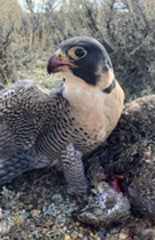
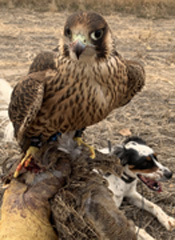
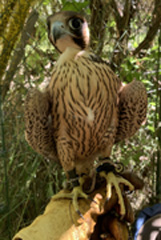
Photos of his Peregrine Falcons © 2023 Art Haschak
Join us this evening for a fascinating presentation by local falconer Art Haschak. Art grew up in Willits and has been flying falcons and hawks since he was 17 which means he's in his 51st year as a falconer. When Art last spoke to PAS about 10 years, he brought his female Peregrine “Sis-Sis” and discussed general raptor identification. This time he'll focusing on the various races of Peregrine with a little insight on the differences between Peregrines and Gyrfalcons, Prairie Falcons and Merlins. Art currently has a seven year old daughter of Sis-Sis, a six month old daughter, and a one and a half year old Red-Naped Peregrine, which is native to the Middle East and Africa. He hopes to bring at least one of these birds as we discuss the interesting differences in hunting styles between the different falcon species.
Get to Know Your Local Birds!
Monday, December 11, 2023 at 7PM - Ukiah City Council Chambers
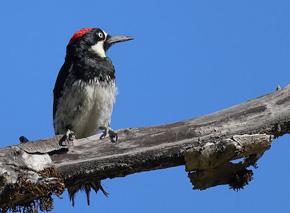
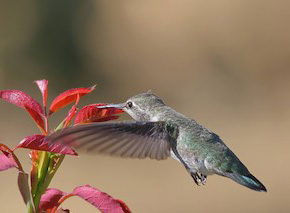
Acorn Woodpecker and Anna's Hummingbird by Kent Leland. Photos © 2023
This evening will be our annual Know Your Local Birds Slideshow and Christmas Bird Count Review with George Gibbs and Bob Keiffer. Bob will be presenting his excellent slideshow introduction to our local wintering birds. George will update us on signup details.
Winter is here, the holidays are with us, and our local birds are helping themselves at our feeders again. Every year I am determined to identify those little critters, each and every one! Sure I make some progress, but what of those tough ones that look so similar, those little brown jobs hopping around under the feeder? Yes, I know most are sparrows and surely those feeding above are finches, but which species is each? I definitely need an expert!
Peregrine Audubon's Christmas Bird Count (CBC) has those experts who can help bring us a step closer to our goal. Join us on Monday, December 11 at 7:00 p.m. in the Ukiah City Council Chambers when Bob Keiffer will point out distinguishing field marks of our Ukiah area birds. He will discuss and illustrate the sparrows and finches, jays and blackbirds, ducks and waders, as well as the raptors, the hawks and owls, all in living color.
Bring your tough questions for the experts. What birds can I expect in my back yard this winter? How do sparrows and finches differ? Is it really possible to see eagles in the Ukiah Valley? What are the ducks and gulls at Lake Mendocino? Anyone interested in bird calls? Our speaker can help with that too.
Peregrine Audubon also offers help in the field. Beginners and experienced birders can come to the December 11 meeting at 7PM and sign up for the Count, which takes place on Saturday, December 16. We will explain how the Christmas Bird Count works, introduce team leaders, and match you with a group that can best help take you that next step toward better bird biology.
The really avid begin before daybreak and in all kinds of weather. The rest of us can participate for parts of the day or even count at home if we live within the 15-mile diameter count circle (which includes Ukiah). There will be a beginners' count starting at 10AM and meeting at the gate to Mendocino College on Hensley Creek Road..
We meet after the CBC for a potluck dinner in the Grace Hudson Museum Public Room on South Main Street. Bring a dish, something to drink, and your eating utensils and join us at 6:00 p.m.
Karla Bloem on a Real Life Great Horned Owl Soap Opera
Tuesday, January 16, 2024 at 7PM - Zoom Meeting
To receive a link, subscribe to our mailing list on our home page.
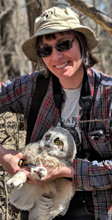
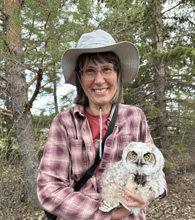
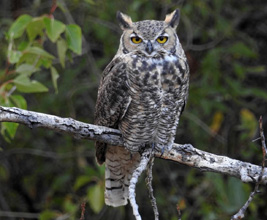
Photos: Karla Bloem, banding and holding Great Horned Owlets, © 2023 Karla Bloem, Adult Great Horned Owl © 2023 Mary Rumple and the Macauley Library
Join us on Zoom for a fascinating evening with Karla Bloem, the founder and Executive Director of the International Owl Center. Karla acquired Alice the Great Horned Owl to use in educational programs in 1998 and began studying Great Horned Owl vocalizations in 2004. Since then, a real-life soap opera has played itself out with over 25 captive and wild Great Horned Owls that have formed the basis of an in-depth vocal study on the species. You'll experience owl dating, divorce, territorial defense, and more as you learn about their vocalizations and their meaning. And one of Karla's owls will join her in a live appearance.
Karla is now the world authority on their vocalizations and has given presentations in The Netherlands, Germany, Argentina, Italy, Portugal and South Africa. Alice’s popularity led Karla to create the International Festival of Owls, the first full-weekend, all-owl event in North America that has served as the inspiration for similar festivals in Italy, Nepal and India. Karla and Alice testified before the Minnesota House and Senate environment committees to successfully gain protection for Great Horned Owls in 2005. Karla received the Brother Theodore Voelker Award from the Minnesota Ornithologists’ Union in 2001, was awarded a Bush Leadership Fellowship in 2008 and a World Owl Hall of Fame Special Achievement Award in 2021. She has assisted several authors (including Jennifer Ackerman) and filmmakers and has appeared on Animal Planet and the CBC’s “The Secret Life of Owls.”
The international Owl Center the only all-owl education center in the United States. It opened in an historic storefront in the little town of Houston, MN (population 979) in 2015, with owls commuting to work in the Owlmobile each day from their aviaries in the country. Property for a new 22,000 square foot facility in a park at the edge of town has been acquired, architectural concepts are now completed, and the silent fundraising phase is starting this winter. You can see the plans at www.InternationalOwlCenter.org/future.
Special thanks to Redbud Audubon for their contribution to the program description.
Leslie McGinnis on Monarch Butterflies in the Garden
Tuesday, February 20, 2024 at 7PM - Zoom Meeting
To receive a link, subscribe to our mailing list on our home page.
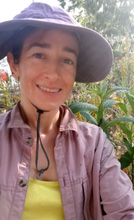
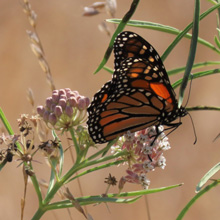
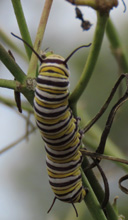
Leslie McGinnis, Monarch Butterfly and 5th instar Monarch caterpillar photos © 2024 Leslie McGinnis
Join us for an evening all about monarch butterflies, monarch caterpillars, and the amazing interactions happening everyday in our suburban and urban garden ecosystems! The focus of this talk will be on the threats facing monarch caterpillars and how to use ecological concepts to guide management decisions in our own gardens. Growing milkweed has increased dramatically in recent years, but gardeners can be overwhelmed with recommendations on what to grow and how to grow it. We will learn about some of the general recommendations, the science behind them, and how understanding our own gardens can help us tailor recommendations to our own garden ecosystems. We will also learn about the dissertation research of our speaker, Leslie McGinnis. The focus of Leslie’s dissertation is on the milkweed gardens of the East Bay of the San Francisco Bay Area. Specifically, she is interested in (1) the social, commercial, and ecological processes shaping and connecting these gardens, (2) the plant species composition of these gardens and winter availability and care of milkweed, (3) community ecology surrounding predation of urban monarch caterpillars, (4) how host plant species traits, garden landscape characteristics, and season impact predation pressure on caterpillars.
Leslie McGinnis is a doctoral candidate at the University of California Berkeley. Leslie grew up gardening in a rural area outside of Spokane, Washington in the foothills of the Selkirk Mountains. As a little girl, she would go with her family to old homesteads and fields and rescue heirloom perennials and native plants before they were bulldozed. Leslie earned her BS at the University of Washington studying topics ranging from the impacts of ecotourism on southern resident orcas, to the impacts of non-native tamarisk on insect communities, to tropical forests, to the evolutionary ecology of chili peppers. After graduating, she taught middle school science in Los Angeles with Teach For America. During this time, she earned her teaching credential and partnered with the Sierra Club Inner City Outings program to take her students on hiking and camping trips in the Santa Monica Mountains and to tidepool and salt marsh ecosystems. Leslie earned her M.S. in Ecology and Evolutionary Biology at the University of Michigan Ann Arbor with a strong emphasis on agroecology and continued her graduate studies in Berkeley. In addition to her doctoral research, Leslie has continued her commitment to education and increasing diversity in STEM fields. She has taught courses on urban gardening and agroecology, climate change in California, insect natural history, and interactions between society, culture, and the environment. Additionally, she guided Environmental Science senior thesis students through the development and completion of individual research projects and mentored incoming first generation college students through Berkeley’s Bridge Connect program. Firmly believing that science is for everyone, Leslie values research and research methods that are accessible to the general public and that honor the wealth of knowledge of gardeners, farmers, and backyard naturalists. More about Leslie at her website.
Ashton Kluttz of the Sonoma Bird Rescue Center
Tuesday, March 19, 2024 at 7PM - Ukiah City Council Chambers
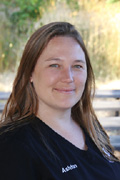
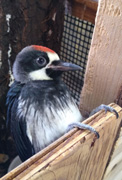
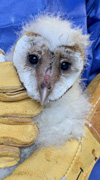
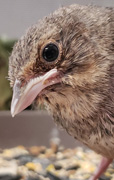
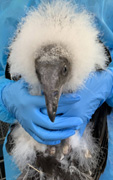
Ashton Kluttz, Acorn Woodpecker, Barn Owl, California Towhee, and Turkey Vulture. Photos © 2023 The Bird Rescue Center
Did you know The Bird Rescue Center, located in Sonoma County, sees roughly 100 patients from Mendocino County? Our work has never been more important in this climate change-driven era. Come learn about The Bird Rescue Center and hear behind-the-scenes stories of Bird Rescue and unique avian observations from Ashton Kluttz, Executive Director of the Bird Rescue Center in Santa Rosa.
The current Executive Director of The Bird Rescue Center, Ashton Kluttz completed her BA in Environmental Studies at Washington College (MD). She began her tenure with Bird Rescue in 2010 and her career as a wildlife rehabilitator in 2009 with The Marine Mammal Center where she served in the Stranding Department. Striving to provide the best care for our local wildlife, she obtained her Registered Veterinary Technician certification in 2018, has co-authored a chapter on towhee care currently included in a wildlife care book for facilities around the world, and served on the board for the California Council for Wildlife Rehabilitators that provides community, protocols, and information to all California wildlife facilities.
Under her direction, Bird Rescue has forged stronger relationships with other wildlife and education facilities and within the community. She has come to appreciate individual species’ behaviors and could discuss their quirks at length. In her spare time, she catches up with her family on the East Coast and enjoys taking photos of food on her dogs' noses.
Peter Van De Burgt on Salmon Habitat Restoration on the Ten Mile and Garcia Rivers
Tuesday, April 16, 2024 at 7PM - Ukiah City Council Chambers
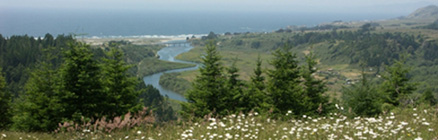
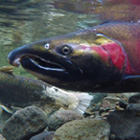
Ten Mile River estuary photo © Nature Conservancy, Coho Salmon photo © Bureau of Land Management
Join us this evening as Peter Van De Burgt updates us on salmon habitat restoration on some of our local rivers. On the North Coast, The Nature Conservancy is working to protect and restore a network of coastal floodplains and estuaries that includes the coastal reaches of the Ten Mile River, the Navarro River and the Garcia River. This network will conserve biodiversity, increase coastal resilience, and provide some of the southernmost habitat for wild coho salmon along the Pacific Coast.
Our work is about improving conditions in these rivers and their estuaries by reconnecting floodplains, building wood jams (large structures within the streams themselves), and restoring the natural form and function of whole riverscape systems. This work provides critical habitat for fish and it's helping to demonstrate the effectiveness of estuary and floodplain habitat restoration, creating a blueprint that can be replicated across the region. To date, TNC has constructed three large restoration projects in the Ten Mile River and one in the Garcia River estuary, with three more projects slated for construction in the coming years."
A quick recent success story: This winter, in the Ten Mile River, we have observed more adult salmon returning to the river to spawn than we have ever seen in our 10+ years of monitoring. It is looking like this will be the best spawning year for coho salmon that we have seen in a long, long time! A glimmer of hope for a species otherwise teetering on the brink of extinction in California.
Dave Bengston on Attracting Birds to Your Yard
Tuesday, May 21, 2024 at 7PM - Ukiah City Council Chambers
Details to follow
Field Trips
Field Trip Guidelines: Everyone is welcome! These guidelines apply to all Peregrine Field Trips. Please take a moment to read them if you are new, or use them to refresh your memory if you have birded with us before. The times listed are the departure times - not the assembly times. Please arrive early! Many of the trips are out of the area and require an hour or more of driving, so promptness is necessary.
Due to insurance requirements, Peregrine Audubon leaders are not allowed to organize carpools. Participants are, however, encouraged to voluntarily share rides. Any carpool arrangements are private arrangements between the driver and the passengers. Drivers must carry adequate insurance coverage. Please be courteous and share gas expenses with the driver
Most trips are all day affairs, but at times various people need to get back sooner. By arriving 15-20 minutes early such necessary travel arrangements can be made. You will probably want to take a pack with lunch, water, hat and appropriate clothing - coats, rain gear, etc. - , binoculars*, camera, and perhaps notepad and field guides.
*Binoculars are important, but loaner pairs may be available for newcomers. If you have some to loan, please bring them along.
Clear Lake State Park
Saturday, September 23, 2023
Join us for a morning of birding at Clear Lake State Park. This beautiful park has a variety of habitats that support a great diversity of birds, and it is a great time of year to be out in the oaks enjoying the fall colors. Expect to see some birds we seldom see in Ukiah- American White Pelicans, Bonaparte’s Gulls, and an abundance of water birds. We depart from the CVS parking lot at 8 am, and should arrive at the Visitor Center by 9 if you prefer to meet us there. Parking fee is $8 per vehicle. Be sure to bring a lunch and something to drink for a picnic in the park. For those wishing to continue birding in the afternoon, we will probably be visiting the Lakeside County Park and Rodman Slough areas on our way back to Ukiah.
Willits Mitigation Lands and Waste Water Treatment Plant
Saturday October 21, 2023
Peregrine Audubon in conjunction with MCRCD, Mendocino County Resource Conservation District, will be doing a bird focused field trip on the Willits Bypass Mitigation Lands along Outlet Creek. We hope to see early raptors migrating into the valley, White Tailed Kites and Early Northern Harriers, and see the tail end of the neotropical migration south along the riparian corridors. The Dogwood, poison oak, blackberry, and rose hips will be ripe and attracting may juvenile birds on their migration from north to south for the Fall and Winter. The tule Elk should have begun bugling so we should hear some of them too.
This trip will have limited space available so you must RSVP at: marisela@mcrcd.org We will meet at 8:30 at the Mendocino County Museum.
Covelo and Round Valley
Saturday, November 18, 2023
Join us for a fall visit to the Round Valley area, one of our favorite destinations. This beautiful valley with its open grasslands and large Valley Oaks is home to a number of winter visitors not commonly seen in the Ukiah area. In past years birds of note here have included Bald Eagles, Ferruginous and Rough-legged Hawks, Peregrine and Prairie Falcons, Lewis’s Woodpeckers, and Canyon Wrens. Time and weather permitting we will continue east to the Black Butte/Eel River campground for a picnic and more birding. Meet before our 8:00 am departure from the CVS parking lot, or at 8:30 at the parking lot in front of Willits High School. We should reach Covelo and Keith’s Market around 11:00.
Ukiah Christmas Bird Count
Saturday, December 16, 2023
The CBC itself is a good opportunity for birders of all experience levels to help us identify and count birds. For details, please attend our December 11 presentation at the Ukiah City Council Chambers or contact George at ggibbs@pacific.net.
Sacramento National Wildlife Refuges
Saturday, January 20, 2024
Join us on a trip to the Sacramento Valley waterfowl refuges. These areas host tens of thousands of waterfowl during the winter, in numbers and diversity far beyond anything in Mendocino County. We can count on seeing such locally rare birds as Snow and Ross's Geese, Eurasian Wigeon, Blue-winged Teal, White-faced Ibis, Black-necked Stilt, Sandhill Crane, Loggerhead Shrike, and others. Two places to meet for this trip: we will leave from Willits at the Evergreen Shopping Center in front of RiteAid and from Ukiah at the CVS parking lot, both at 7:30 AM. The two groups will meet up at Granzella's in Williams at 9:30 AM. Dress in layers and bring food and drink for our picnic lunch.
Beginner’s Bird Walk at the Ukiah Wastewater Treatment Plant.
Saturday, February 24, 2024
At the Ukiah Wastewater Treatment Plant, or UWTP, you can probably see more species of birds in less time than anywhere else in the Ukiah valley. Its habitat range is outstanding: riparian areas adjacent to the Russian River, settling ponds, beautiful stands of mature valley oaks, blackberry thickets, and adjacent open grasslands. Meet at the UWTP office area at 8:30. The walk around the oxidation ponds is about one mile, all on level ground.
Lake Mendocino North Shore
Saturday, March 23, 2024
We will be birding the north end of Lake Mendocino this morning. We will be focusing on the stretch between the boat launch adjacent to the inlet, and along the Pomo A day-use area. There are great views of the lake from this location, so we will be searching through the water birds for wintering ducks and grebes. Loons are a possibility here as well. Other target birds will include wintering song birds and raptors along the lake shore. Bald Eagle is a good possibility. We will be leaving the CVS parking lot at 8:00 and expect to arrive at the parking area above the north boat launch at 8:30.
Hopland Research and Extension Center
Saturday, April 27, 2024
We will be birding this beautiful 5300-acre field station on a trip led by Chuck Vaughn. We will visit a variety of habitats including oak woodlands, chaparral, and riparian areas, and will see and hear the diversity of birds that live there.We hope to see residents like Bell's and Rufous-crowned Sparrows. If our timing is good we might also see Golden Eagles, Grasshopper Sparrows, and a number of neotropical migrants. This trip requires short hikes. We will leave from the Ukiah CVS parking lot at 8:00 am, or you can meet us at the Hopland Center at 8:30. Bring your lunch, water, and binoculars. RSVP is required for this field trip as there is limited space, and reservations will be made for Pereegrine members only on a first-come basis. Please send an email to Chuck Vaughn (cevaughn@pacific.net).
Potter Valley and the Eel River
Saturday, May 4, 2024
The primary birding on this trip is done along the scenic main stem of the Eel River with stops at the Pioneer Bridge, Trout Creek, and possibly Burris Lane. Both MacGillivray's and Hermit Warblers are usually seen on this trip, and they can be difficult to find elsewhere in the county. Other possible birds include Bald Eagle and American Dipper. We will leave from the Ukiah CVS parking lot at 8:00 am, or you can meet us at the old Potter Valley bridge site along the Russian River (1/4 mile north of Hwy 20 on Potter Valley Road) at 8:30. Bring your lunch, water, binoculars, and favorite field guides.

Last revised April 03, 2024.